Host group
Crinoid echinoderms, especially feather stars.
Discover the small squat lobsters, shrimps, crabs and clingfishes that shelter among the branching arms of feather stars.
Feather stars are crinoid echinoderms whose branching arms create a complex living habitat for a range of small marine animals.
Certain squat lobsters, shrimps, crabs and clingfishes can live among the arms and pinnules. They may use the feather star for shelter, camouflage or access to food-rich water flow, but these different associations must not all be described as mutualistic.
Finding these animals rewards patience. Divers should observe from a respectful distance and never touch, lift, spread or reposition the feather star to reveal a hidden subject.
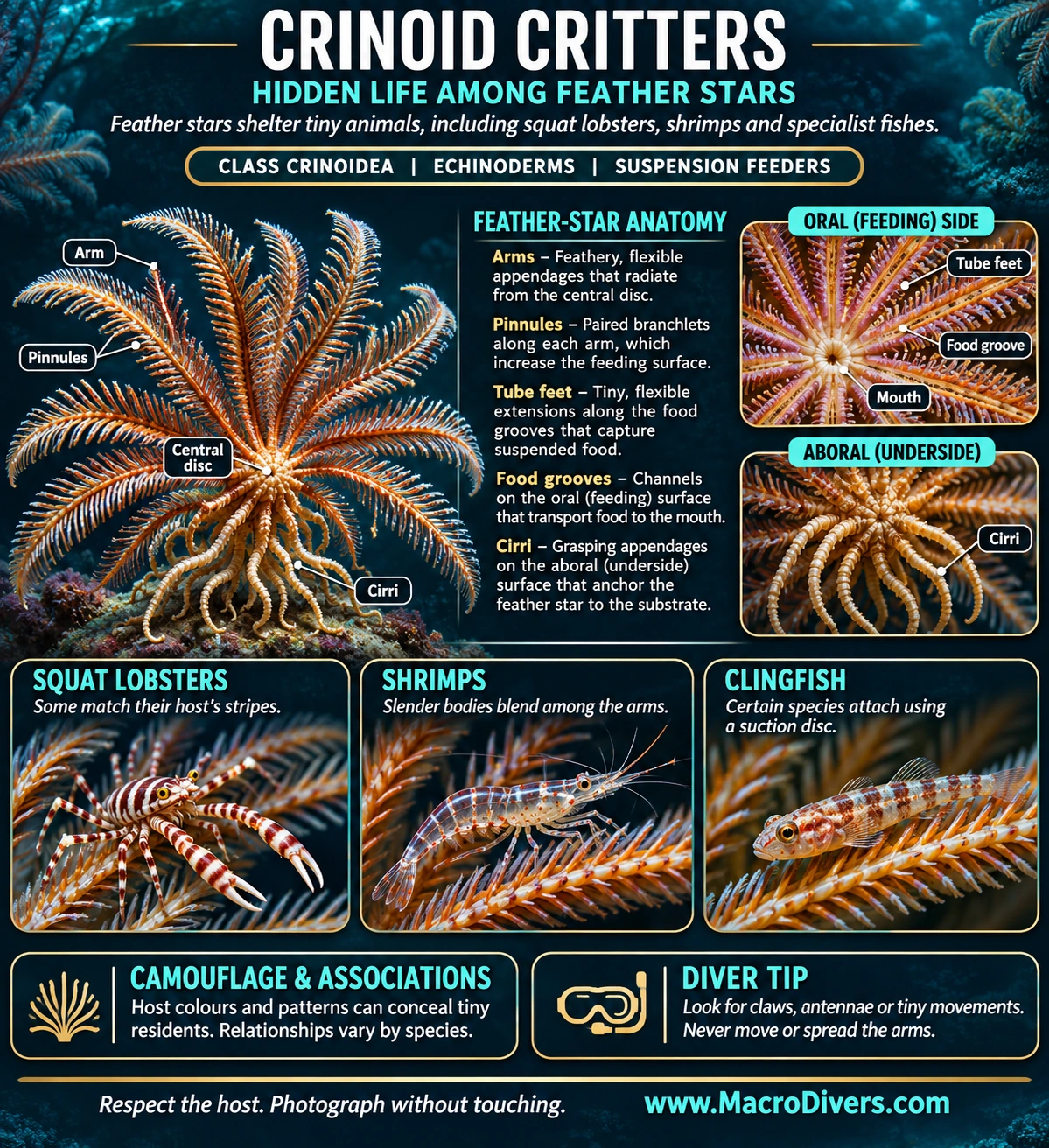
Crinoid echinoderms, especially feather stars.
Mobile, unstalked feather stars with many branching arms.
Feather stars filter suspended food particles from the water.
Squat lobsters, shrimps, some crabs and crinoid clingfishes.
Central disc, arms, pinnules, oral surface and cirri.
Shelter, camouflage and feeding opportunities.
Look for a small shape or pattern that interrupts the host's outline.
Host matching, tiny details and strong environmental context.
Feather stars are animals, not plants. They belong to the crinoids, a group of echinoderms related to sea stars, brittle stars, sea urchins and sea cucumbers. Unlike stalked sea lilies, adult feather stars are usually unstalked and many can move across the reef.
Their feather-like arms carry rows of small side branches called pinnules. Together these form a large filtering surface that helps the feather star capture suspended food particles from moving water.
The same dense structure creates hiding places for small associated animals. Some are so closely matched to the host's colour and pattern that they can disappear among the arms.
The compact central body from which the arms extend.
Long, branching structures used to form the feeding fan.
Small side branches along each arm that help collect suspended food.
The feeding side of the central disc, where the mouth is located.
Claw-like gripping appendages that many feather stars use to hold onto the substrate.
The arms and pinnules create shelter and feeding space for associated animals.
Small crustaceans, including members of Allogalathea, can shelter closely among the arms. Many show stripes or colour patterns that resemble their host.
Slender, well-camouflaged shrimps may live between the arms and pinnules. Identification often requires clear views of fine anatomical detail.
Some small crabs associate with crinoids. Use a broad group name unless reliable features support a more precise identity.
Tiny specialist fishes such as Discotrema species can attach themselves among the arms and remain difficult to spot.
The phrase "crinoid critters" is a useful diving term, but it covers animals with different natural histories. One species may use the host mainly as shelter, another may feed in the surrounding water, and another may interact with the host in a different way.
It is therefore inaccurate to call every association mutualistic. Unless a particular interaction has been studied, describe the animal as living on, sheltering in or being associated with a feather star without claiming that both species benefit.
Camouflage can be strong enough that the animal becomes visible only when it moves. This is why slow observation is more effective and less disruptive than manipulating the feather star.
Feather stars are living animals, not movable backgrounds. Handling the host can damage delicate structures, interrupt feeding and disturb every small animal sheltering among the arms.
Crinoid critters can make striking macro subjects because the host provides colour, pattern and environmental context. The strongest photographs show the association without sacrificing the welfare of either animal.
Look only where feather stars occur naturally and allow the host's position and water flow to remain unchanged.
The Coral Triangle provides regional context for diverse reef and macro marine life.
Explore the macro diving destinations guide for wider habitat and travel context.
Crinoid critters depend on the host and its surrounding habitat. Reef damage, sediment, pollution and direct disturbance can reduce the shelter and feeding conditions these small animals use.
Divers can help by maintaining excellent buoyancy, avoiding contact with the host, supporting responsible guides and leaving the whole association exactly as they found it.
No. Feather stars are animals. They are crinoid echinoderms related to sea stars, brittle stars, sea urchins and sea cucumbers.
Associated animals can include certain squat lobsters, shrimps, some crabs and specialist clingfishes. The exact community varies with the host, habitat and location.
No. Different associations have different effects. Unless an interaction has been studied, it is safer to describe the animals as associated with the feather star rather than assume the relationship is mutualistic.
Approach slowly and inspect the arms and pinnules without touching or moving the feather star. Look for small changes in outline, colour or pattern and allow the host and associated animals to remain undisturbed.
No. Divers should never touch, lift, spread or reposition a feather star to expose an animal.
No. Many associated animals are small and similar-looking. Use a broader group name when the photograph does not show enough reliable features for species-level identification.
Feather stars reward divers who slow down and look carefully. A patient observer may find an entire hidden community without ever touching the host or changing the animals' natural behaviour.
Read about camouflage, host habitats and careful macro observation.
Read SeahorsesMeet host-specialist shrimps and other Coral Triangle favourites.
Read Macro ShrimpsImprove critter encounters with calmer, lower impact diving.
Read The GuideBuild better macro photos with careful approach, lighting and composition.
Improve PhotosReturn to the MacroDivers Marine Life Academy hub.
View Marine Life