Equalise early and often
Clear your ears before discomfort starts. Many divers need to equalise every small change in depth during the first few metres of descent.
Diving Skills & Safety
Equalise early, equalise often and never force your ears.
Ear equalisation problems are one of the most common issues in scuba diving. Most trouble starts early in the descent, when pressure changes quickly and divers either wait too long, descend too fast or try to force the ears to clear.
If you cannot equalise comfortably, the safe answer is to stop, ascend slightly if needed and retry gently. If it still does not clear, end the dive. Pain is a warning sign, not something to push through.
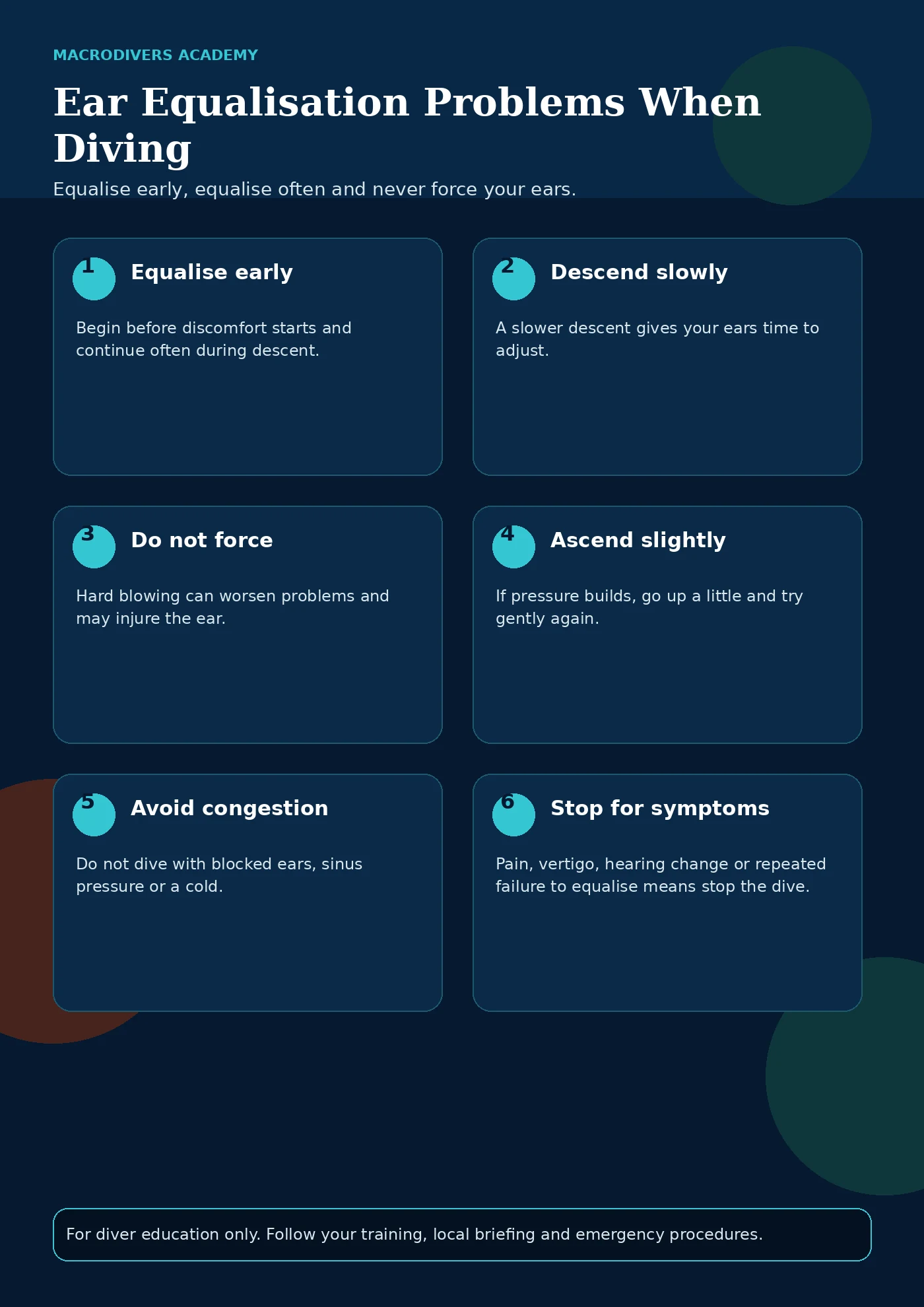
Practical reminders to discuss before the dive and apply within your training and local briefing.
Clear your ears before discomfort starts. Many divers need to equalise every small change in depth during the first few metres of descent.
Good buoyancy and a controlled descent give you time to pause, retry gently and avoid turning a minor clearing issue into an injury.
Middle-ear squeeze, reverse block, trapped air in the outer ear and rare inner-ear injury all feel different. Pain, vertigo, hearing change or blocked equalisation all matter.
Colds, sinus congestion and ear infections increase the risk of failed equalisation and barotrauma. If your ears are not right before the dive, sit it out.
Do not dive with significant congestion, sinus pain, active ear infection or unresolved ear symptoms. If pain, vertigo, sudden hearing change, discharge, bleeding or persistent fullness occurs, stop diving and seek medical advice.
This guide is for general diver education and does not replace formal training, medical advice or the guidance of your instructor, dive centre, emergency services or a diving doctor.
Equalise early and often, before pain starts. Many divers need to equalise every small change in depth during the first few metres.
Stop descending, signal your buddy, ascend slightly and try gentle equalisation again. If it still will not clear, abort the dive.
No. Forceful equalisation can worsen the problem and may injure the ear. Equalisation should be gentle.
Do not dive with significant congestion, sinus pressure or ear fullness. Congestion can prevent equalisation and increase the risk of barotrauma.
A reverse block can happen when expanding air cannot escape during ascent, causing pain or pressure. Stop, stay calm and follow your training and dive leader guidance.
Seek advice if pain, vertigo, hearing change, bleeding, persistent fullness or symptoms after diving occur. Do not keep diving with unresolved ear symptoms.
Return to the Diving Skills & Safety section to explore other practical safety and first response guides for divers.
Return to Diving Skills & Safety