Why are hand signals important in scuba diving?
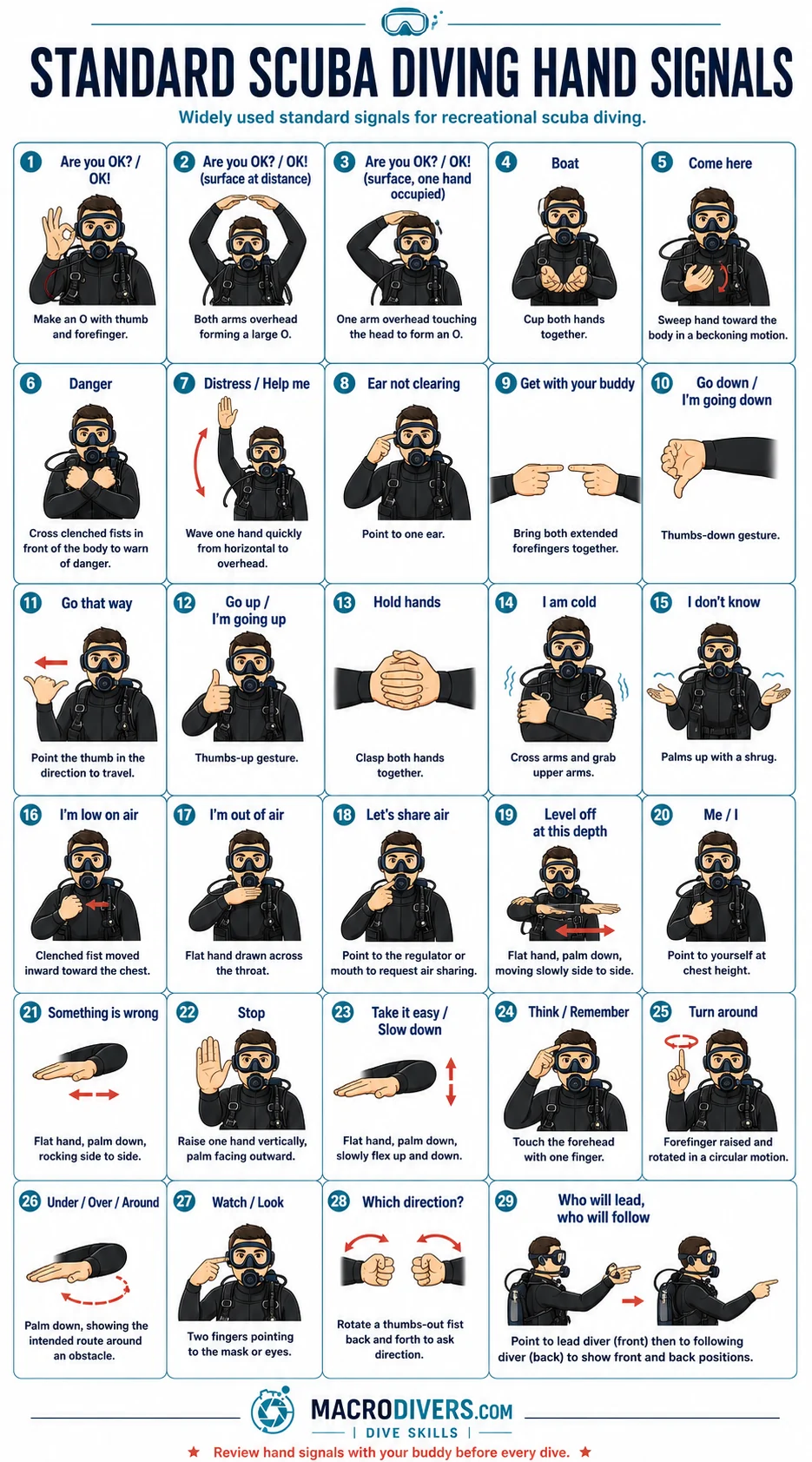
Hand signals allow divers to communicate clearly underwater when speech is not possible. They help buddies manage direction, depth, gas, problems and safety decisions.
Diving Skills & Safety
Clear underwater communication for safer, calmer, better buddy diving.
Good hand signals make diving calmer, safer and more enjoyable. Underwater, your buddy needs to know whether you are OK, where you are going, how much gas you have and whether something has changed.
This guide covers two practical groups of signals: widely used standard scuba diving hand signals and common air/gas signals used to ask for and report remaining gas. Signals can vary slightly between agencies, instructors, regions and dive teams, so always review them with your buddy before the dive.
Downloadable guide
Core buddy-team signals for OK, stop, up, down, problem, low on air, out of air, come here, watch me, turn around and related dive-management situations.
Gas checks
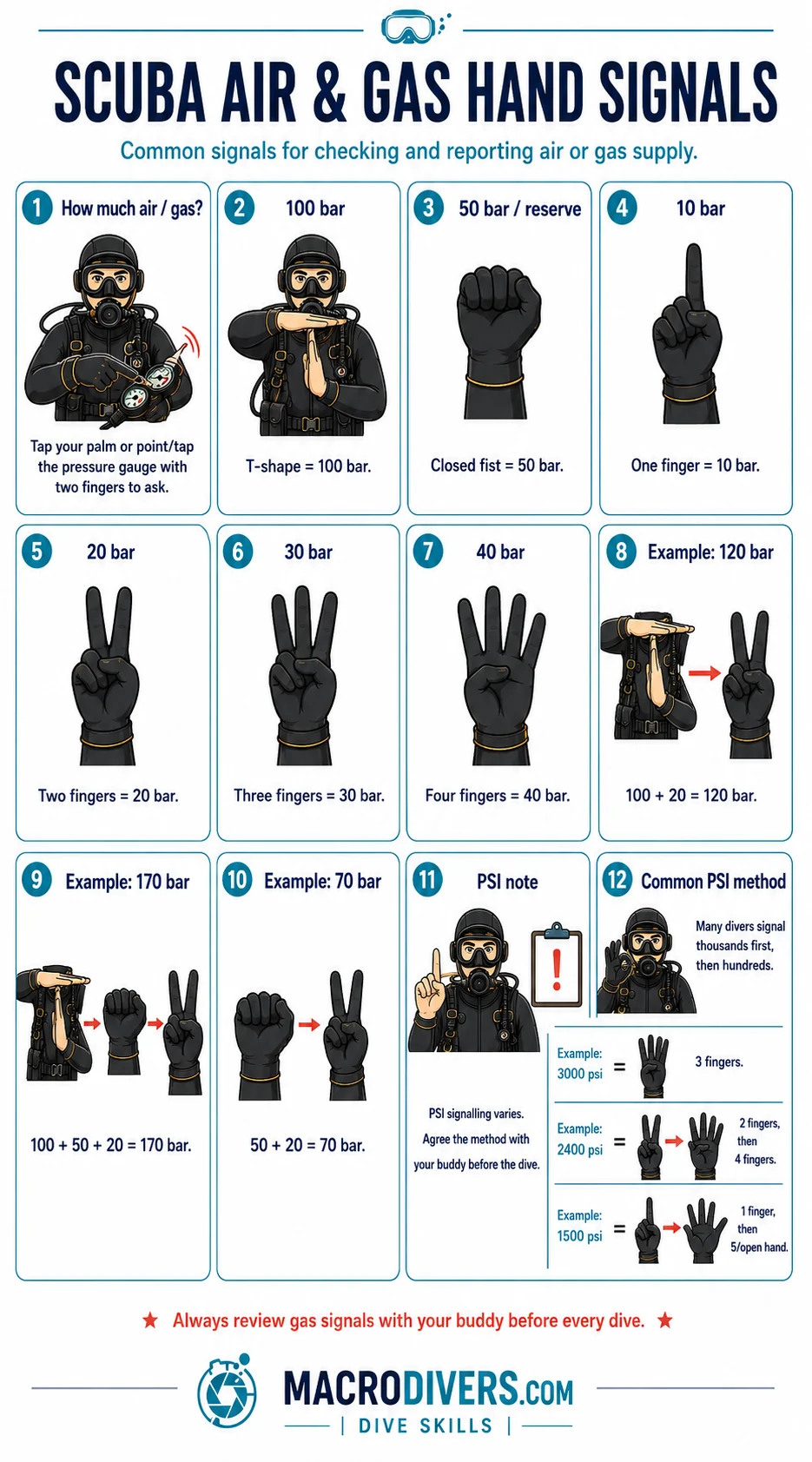
Gas communication should be simple and agreed before the dive. In bar, many divers use a T-shape for 100 bar, a closed fist for 50 bar, and one to four fingers for 10, 20, 30 and 40 bar.
These signals can be combined, such as 100 + 50 + 20 for 170 bar. PSI signalling varies more between teams and locations, so agree the method before the dive. If there is any doubt, show your SPG or dive computer directly.
Marine-life signals are useful, but they are much less standardised than core safety signals. Dive guides often use local signs for sharks, turtles, rays, octopus, nudibranchs and other animals. These can vary by region, guide and dive centre.
We plan to add a separate marine-life hand signals guide later, with clear notes on regional variation and source references.
After dark, standard hand signals still matter, but divers often use a torch to get attention or illuminate the signal so a buddy can see it clearly.
View night diving torch signalsHand signals allow divers to communicate clearly underwater when speech is not possible. They help buddies manage direction, depth, gas, problems and safety decisions.
The core safety and buddy signals are widely recognised, but some signals vary between agencies, instructors, regions and dive teams. Always review signals before the dive.
A common low-on-air signal is a clenched fist moved inward toward the chest. Divers should agree turn pressure and reserve pressure before the dive.
Many divers use a T-shape for 100 bar, a closed fist for 50 bar, and one to four fingers for 10, 20, 30 and 40 bar. These signals can be combined to show pressures such as 120, 150 or 170 bar.
No. Marine-life signs are often local or guide-specific. A shark signal may be widely understood, but many critter and fish signs vary between regions.