Agree the plan on the surface
Discuss entry, route, maximum depth, turn pressure, torch signals, navigation, lost-buddy procedure and exit before you get in.
Diving Skills & Safety
Torch communication, simple planning and calm buddy awareness for safer night dives.
Night diving can be calm and spectacular, but it also removes the easy visual communication you take for granted in daylight.
That is why night diving works best when the plan is simple, buddy distance is sensible and torch communication is agreed before you enter the water. The basics are not complicated. What matters is keeping them calm, deliberate and easy to recognise.
Downloadable guide
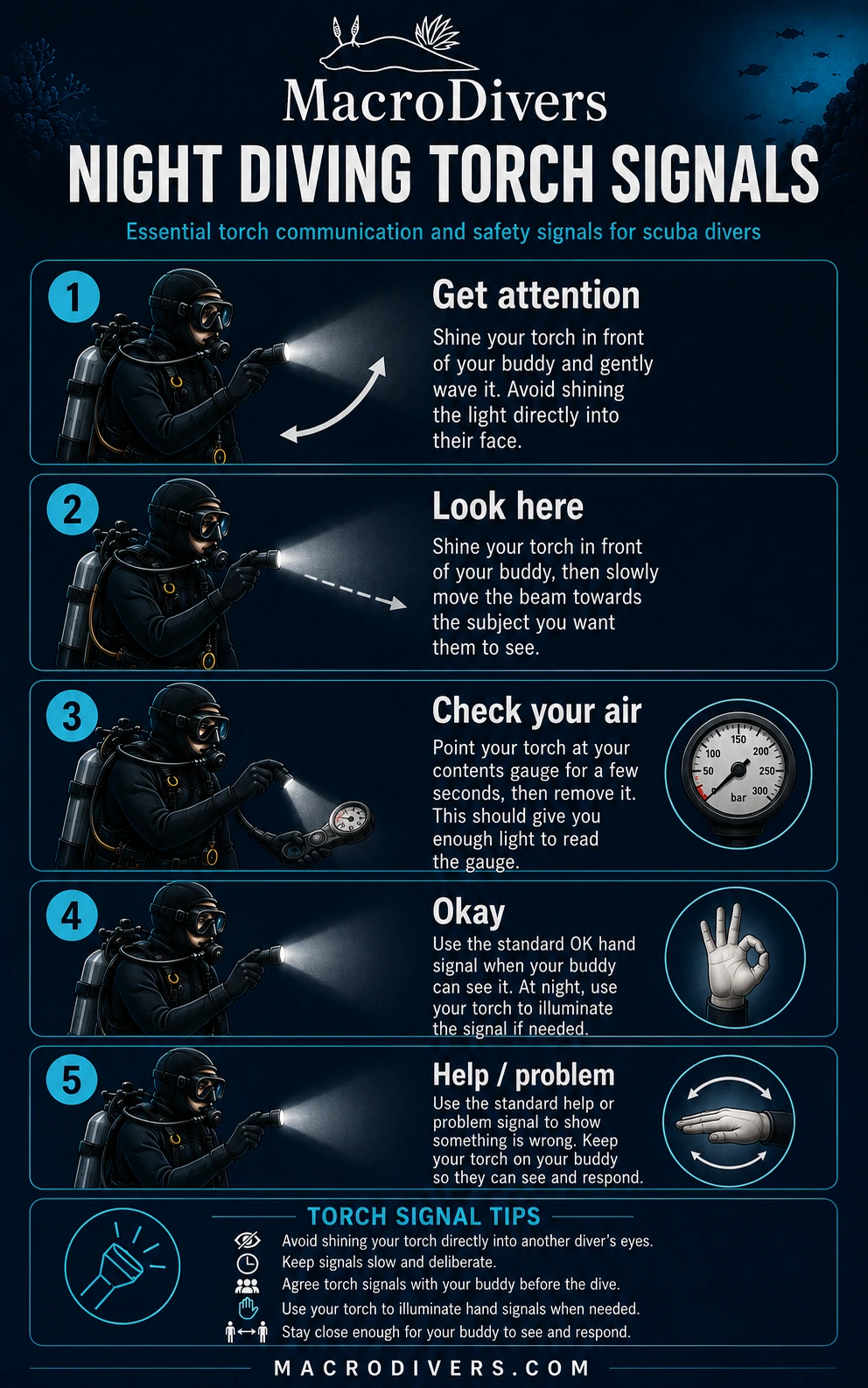
Essential torch communication and safety signals for getting attention, directing a buddy, checking your air, confirming OK and showing a problem.
Good night dives usually feel simple because the planning happened before the descent.
Discuss entry, route, maximum depth, turn pressure, torch signals, navigation, lost-buddy procedure and exit before you get in.
Night diving is not the time for wide buddy separation. You should be close enough for torch signals to be seen and understood.
A primary torch and a backup is the sensible standard. Check batteries, clips and switches before the dive.
Move slowly, avoid unnecessary complexity and do not overload the dive with too many objectives, especially if you are still gaining confidence at night.
Standard hand signals still apply at night. If your buddy cannot see them clearly, use your torch to illuminate the signal or attract attention first. Review the daytime versions here too.
View scuba hand signalsAt night your torch often becomes your main communication tool. Clear torch signals help buddies get attention, share direction, check status and respond to problems.
Shine your torch in front of your buddy and gently wave it. Avoid shining the beam directly into their eyes.
Shine your torch in front of your buddy first, then slowly move the beam toward the thing you want them to see.
Point your torch onto your contents gauge for a few seconds, then remove it. That normally gives enough light to read the gauge clearly.
No. Avoid shining directly into another diver's eyes. Use the area in front of them for communication instead.
No. Standard hand signals still matter. At night you often use your torch to help your buddy see the signal or to attract attention before making it.
Return to the Diving Skills & Safety section to explore other practical diver safety guides and emergency awareness pages.
Return to Diving Skills & Safety