Ask how much gas remains
Use the pressure-check question taught in your training or briefing. Your buddy then responds with the agreed bar or PSI convention.
Diving Skills & Safety
How to ask for, report and confirm remaining gas using a convention agreed before the dive.
Scuba gas pressure hand signals help buddies share remaining-gas information when speech is not possible. The examples below show one common recreational bar-signalling convention, not a universal standard.
Before the dive, agree how to ask how much gas remains, whether you are using bar or PSI, and how each value will be shown. Turn, reserve and surfacing pressures come from the dive plan. If a signal is unclear, stop and show the SPG or dive computer directly.
Printable reference
Use this sheet as a briefing memory aid for 100 bar, 150 bar, 120 bar, 50 bar / low on air and out-of-air communication.
Example bar convention
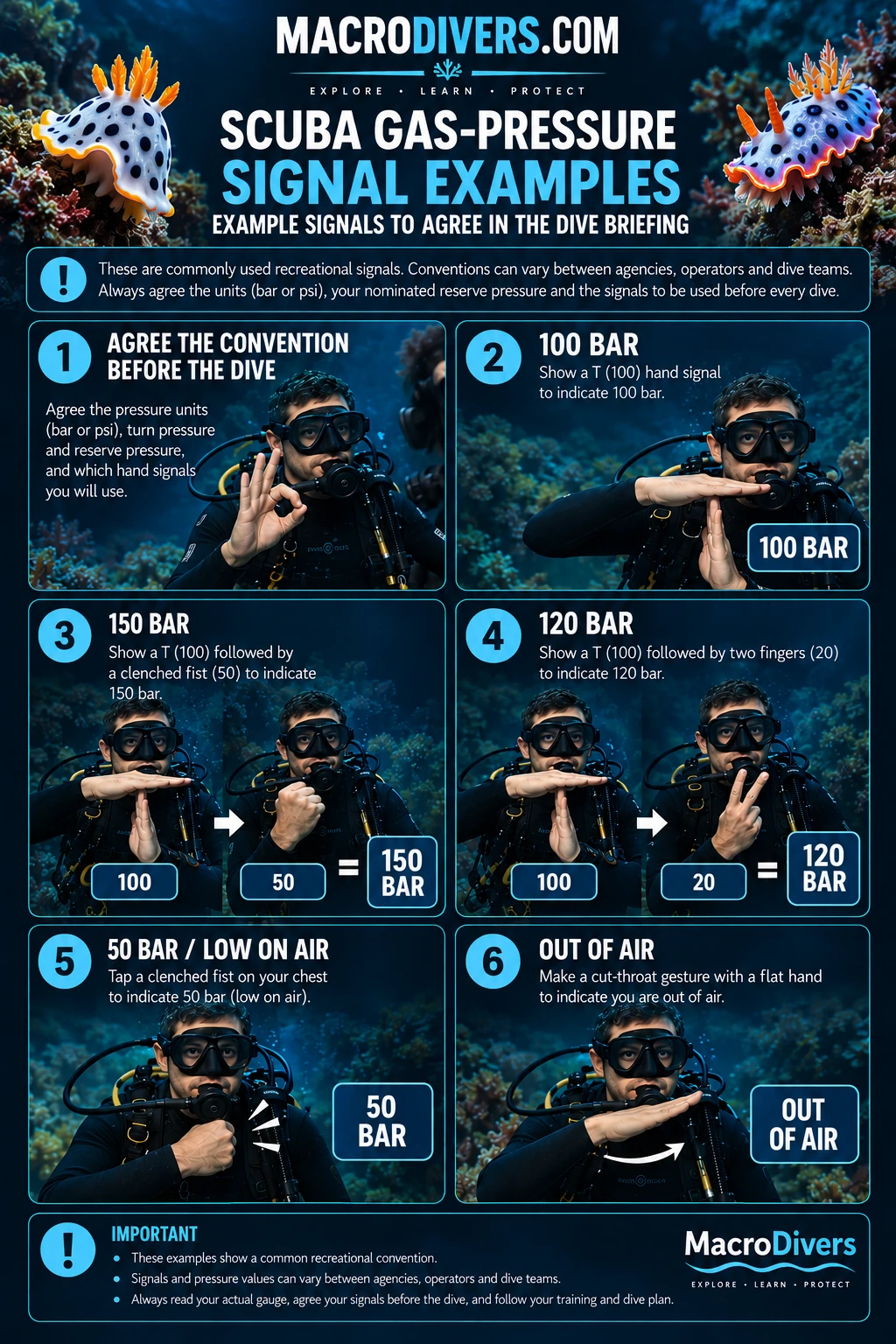
These examples describe the artwork above. Follow your formal training and the convention agreed with your buddy, team and operator.
Use the pressure-check question taught in your training or briefing. Your buddy then responds with the agreed bar or PSI convention.
In this example convention, a T-shape made with both hands indicates 100 bar.
Show the T-shape for 100 bar, followed by a clenched fist for 50 bar. Together they report 150 bar.
Show the T-shape for 100 bar, followed by two fingers for 20 bar. Together they report 120 bar.
In this example, tap a clenched fist on the chest to report 50 bar and communicate low on air. This does not define a universal reserve pressure.
A common out-of-air signal uses a flat hand moved across the throat. Respond according to your training and the agreed emergency procedure.
Bar and PSI use different numbers, and reporting conventions vary between agencies, operators and dive teams. Do not assume a new buddy uses the same system. Agree the units and gestures during the dive briefing.
A reported pressure is information, not a universal turn or reserve rule. Turn pressure, nominated reserve and surfacing pressure come from the dive plan. Read the actual gauge throughout the dive and show the SPG or dive computer whenever the hand signal is uncertain.
Review the broader hand-signal reference as well as the gas-pressure convention, then agree both with your buddy or team.
View all scuba hand signals Diving Skills & SafetyDivers use the pressure-check signal agreed during the briefing. The buddy responds with the agreed bar or PSI convention, or shows the SPG or dive computer directly if there is any uncertainty.
In one common recreational bar convention, show the T-shape for 100 bar followed by a clenched fist for 50 bar. The combined signal reports 150 bar. This convention is not universal.
In the example convention, show the T-shape for 100 bar followed by two fingers for 20 bar. The combined signal reports 120 bar. Agree the convention before the dive.
No. In this example, a clenched fist tapped on the chest reports 50 bar and communicates low on air. Turn, reserve and surfacing pressures come from the dive plan and must be agreed during the briefing.
No. Bar and PSI conventions can vary between agencies, operators and dive teams. Agree the units and signals before entering the water, and show the SPG or dive computer if there is any doubt.