Often Confused With Nudibranchs
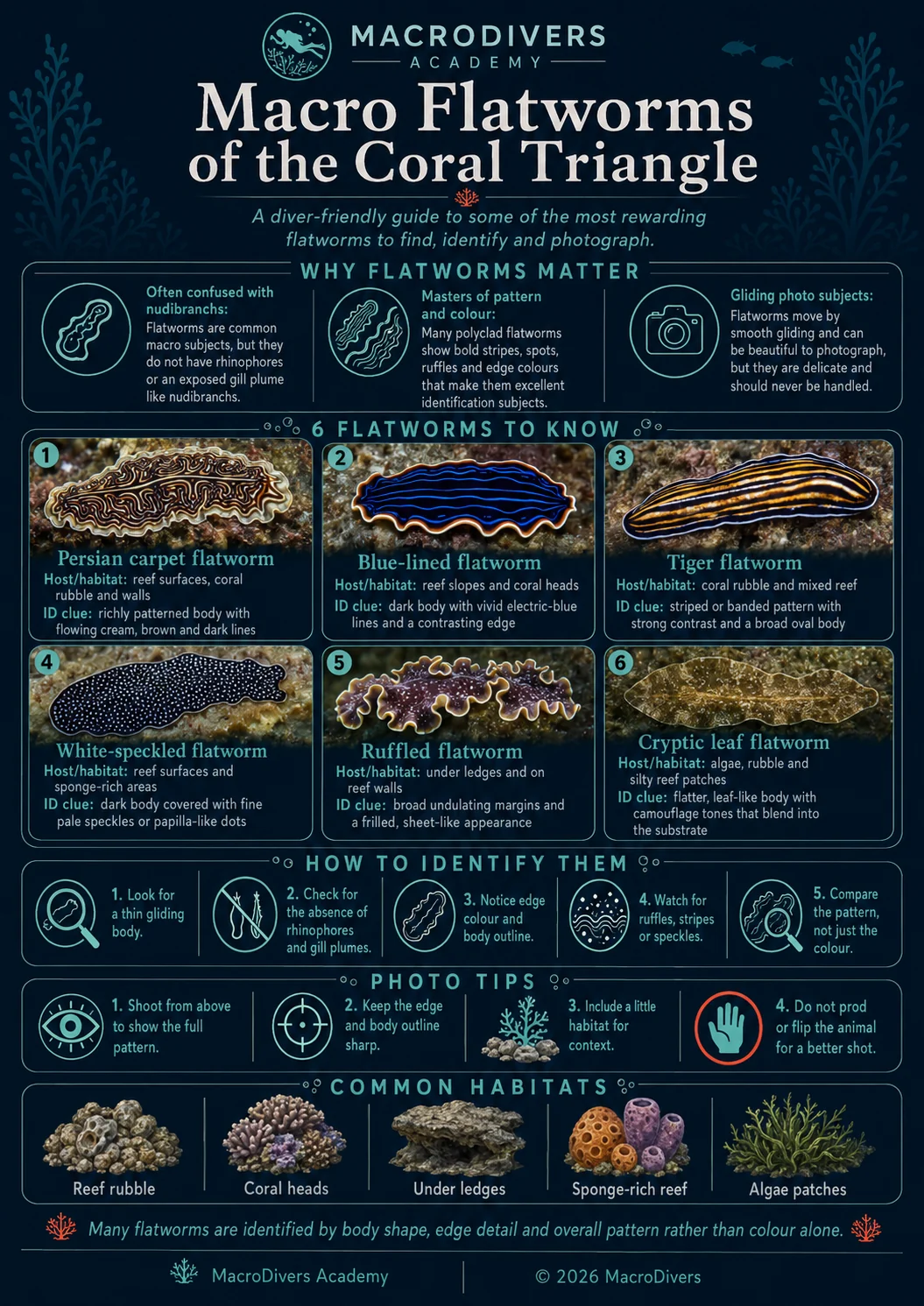
Flatworms are common macro subjects, but they do not have rhinophores, cerata or an exposed gill plume like nudibranchs. Learning the difference helps divers avoid common identification mistakes.
Marine Life
A diver-friendly guide to identifying flatworms, telling them apart from nudibranchs and photographing them without touching.
Flatworms are colourful, delicate and often overlooked macro subjects. In the Coral Triangle, divers may find them gliding across reef rubble, coral heads, sponge-rich areas, algae patches, walls and ledges.
They are often confused with nudibranchs, but flatworms are different animals. They have a thin, soft, flattened body and usually lack the obvious rhinophores, cerata or exposed gill plume that divers use to recognise nudibranchs. For identification, body shape, edge detail and overall pattern often matter more than colour alone.
Flatworms are common macro subjects, but they do not have rhinophores, cerata or an exposed gill plume like nudibranchs. Learning the difference helps divers avoid common identification mistakes.
Many polyclad flatworms show bold stripes, spots, ruffles, edge colours and flowing patterns. These details can make them excellent identification and photography subjects.
Flatworms move by smooth gliding across reef surfaces. They can be beautiful to photograph, but they are delicate and should never be handled, flipped or repositioned.
New macro divers often mistake flatworms for nudibranchs. The easiest starting point is to look for nudibranch features. Nudibranchs usually have rhinophores on the head, and many have either a visible gill plume or rows of cerata. Flatworms usually appear flatter, thinner and more sheet-like, with no obvious rhinophores or external gill plume.
For a deeper comparison, read how to identify nudibranchs and what is a nudibranch.
Host / habitat: Reef surfaces, coral rubble and walls.
ID clue: Richly patterned body with flowing cream, brown and dark lines.
A classic patterned flatworm and a good example of why pattern detail matters more than a quick colour impression.
Host / habitat: Reef slopes, coral heads and hard reef surfaces.
ID clue: Dark body with vivid electric-blue lines and a contrasting edge.
Strong edge colour and line pattern make this type of flatworm visually striking, but compare the whole pattern before assuming an identification.
Host / habitat: Coral rubble, mixed reef and reef slopes.
ID clue: Striped or banded pattern with strong contrast and a broad oval body.
A good subject for overhead photography because the full body pattern is part of the identification story.
Host / habitat: Reef surfaces, sponge-rich areas and shaded patches.
ID clue: Dark body covered with fine pale speckles or papilla-like dots.
Look carefully at whether the surface is smooth, speckled or textured, as this can be more useful than the base colour.
Host / habitat: Under ledges, reef walls and shaded reef surfaces.
ID clue: Broad undulating margins and a frilled, sheet-like appearance.
The edge shape can be the most obvious clue. Try to photograph the outline clearly without disturbing the animal.
Host / habitat: Algae, rubble and silty reef patches.
ID clue: Flat, leaf-like body with camouflage tones that blend into the substrate.
These are often found by noticing movement or outline rather than colour. Search slowly and watch for the body edge.
For broader technique, see the MacroDivers guide to better macro photography.
Flatworms are soft, delicate animals. They should never be touched, lifted, flipped or moved for a photograph. If a flatworm is partly hidden or moving away, leave it alone and photograph what you can. A natural encounter is always more valuable than a staged image.
The same low-impact habits apply across muck and reef sites. Read the MacroDivers guide to responsible muck diving for practical ways to search without damaging the habitat.
The Coral Triangle is especially good for flatworm encounters because of its variety of reef surfaces, rubble slopes, sponge growth, algae patches and muck-diving habitats. Sites in places such as Lembeh, Anilao, Bali, Ambon, Raja Ampat and the wider Indo-Pacific can all produce colourful and cryptic flatworms, especially when divers slow down and search carefully.
No. Flatworms and nudibranchs are different animals. Nudibranchs are sea slugs, while flatworms are soft, flattened worms. Flatworms usually do not have rhinophores or an exposed gill plume.
Look for nudibranch features first. Nudibranchs usually have rhinophores, and many have gills or cerata. Flatworms are usually thinner, flatter and more sheet-like, with a smooth gliding movement.
Yes. Their patterns, edge colours and smooth movement can make them beautiful subjects, especially when photographed from above with careful focus on the body outline.
Flatworms are often found on reef rubble, coral heads, sponge-rich reef, algae patches, walls, ledges and silty reef areas.
No. Flatworms are delicate and should not be touched, flipped or repositioned. Photograph them as found and avoid disturbing the reef around them.
Patterns and colours may help with camouflage, warning signals or mimicry. For divers, these details are useful clues, but identification should be based on the overall body shape, edge detail and pattern, not colour alone.
Learn the head, gill and body features that separate nudibranchs from flatworms.
Read Nudibranch IDReturn to the MacroDivers Marine Life Academy hub.
Return to Marine Life GuidesBuild better macro photos with careful approach, lighting and composition.
Improve Photos