Not True Shrimps
Mantis shrimps are stomatopods, a separate group of crustaceans. They are not true shrimps, but divers commonly use the name because of their shrimp-like body shape and familiar common name.
Marine Life
A diver-friendly guide to finding, identifying and photographing mantis shrimps without crowding or provoking them.
Mantis shrimps are among the most fascinating macro encounters in the Coral Triangle. They are colourful, alert and behaviour-rich, often seen watching from burrows, reef holes, coral rubble or sandy slopes before quickly retreating from view.
Despite the name, mantis shrimps are not true shrimps. They are stomatopods, a separate group of crustaceans with powerful raptorial arms, extraordinary eyes and highly specialised hunting behaviour. For divers and photographers, the challenge is often spotting the eyes, posture and burrow before the full animal appears.
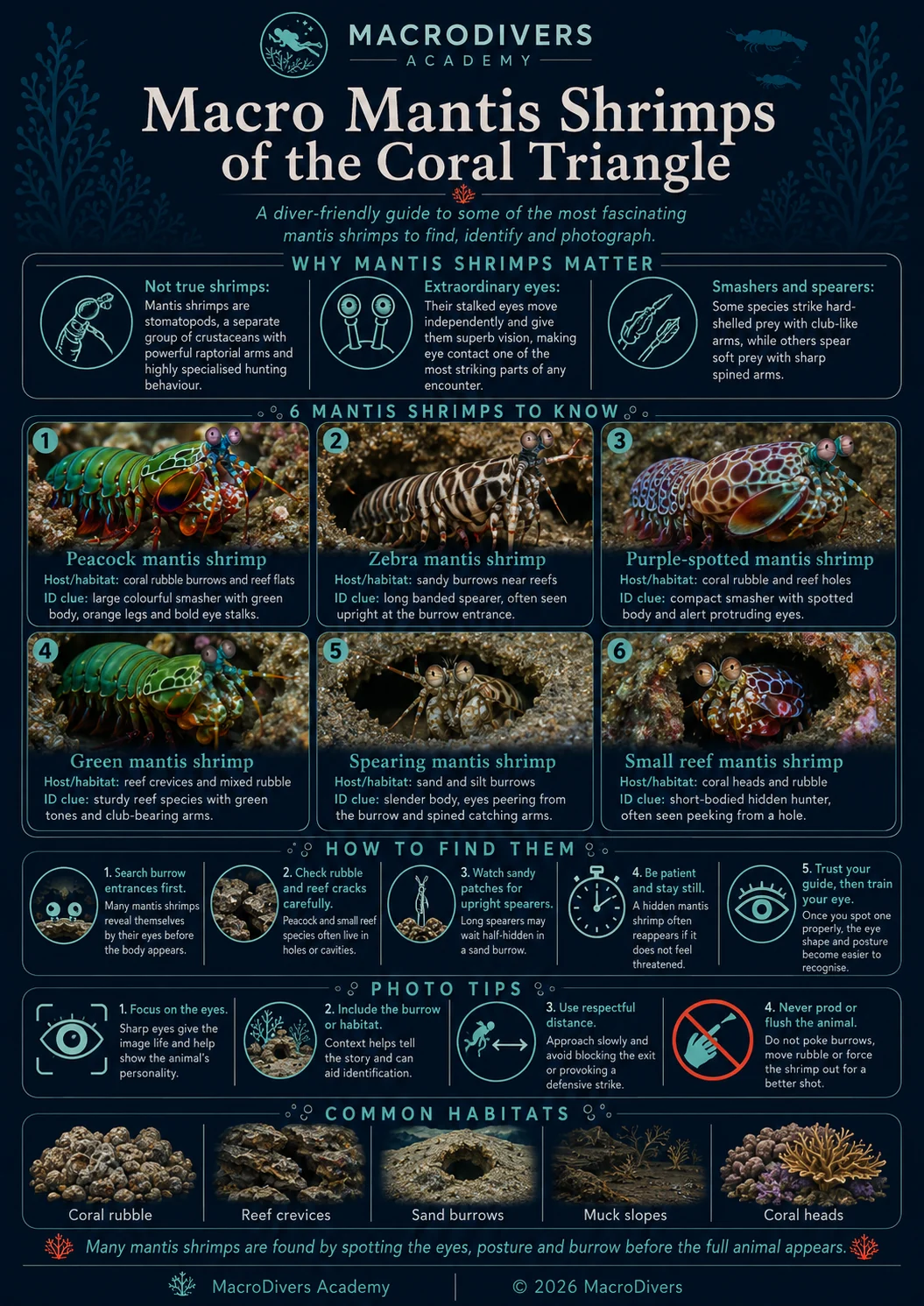
Mantis shrimps are stomatopods, a separate group of crustaceans. They are not true shrimps, but divers commonly use the name because of their shrimp-like body shape and familiar common name.
Their stalked eyes move independently and give them superb vision. Eye contact is often one of the most striking parts of a mantis shrimp encounter.
Some mantis shrimps use club-like arms to strike hard-shelled prey, while others use sharp spined arms to spear softer prey. This difference helps explain their habitat and hunting style.
Mantis shrimps are often grouped by hunting style. Smashers use club-like raptorial arms to hit hard prey such as crabs, snails and shellfish. Spearers use spined arms to grab softer prey, often from sand or silt burrows. Divers do not need to identify every species underwater, but recognising the hunting style helps explain where the animal lives and how it behaves.
If you are comparing them with familiar crustaceans, see the MacroDivers guide to macro shrimps of the Coral Triangle.
Host / habitat: Coral rubble burrows, reef flats and reef holes.
ID clue: Large colourful smasher with green body tones, orange legs, bold markings and prominent eye stalks.
One of the most iconic mantis shrimps for divers and photographers. Photograph calmly at the burrow entrance without blocking its retreat.
Host / habitat: Sandy burrows near reefs, muck slopes and soft sediment areas.
ID clue: Long banded spearer, often seen upright or half-hidden at the burrow entrance.
Look for the vertical posture and eye stalks before the full body becomes visible.
Host / habitat: Coral rubble, reef holes and small cavities.
ID clue: Compact smasher with a spotted body and alert protruding eyes.
Often noticed because of movement or eye contact from a small hole in the reef.
Host / habitat: Reef crevices, coral heads and mixed rubble.
ID clue: Sturdy reef species with green tones and club-bearing arms.
Can be shy and quick to retreat. Stay still and wait rather than pushing closer.
Host / habitat: Sand and silt burrows.
ID clue: Slender body, eyes peering from the burrow and spined catching arms.
These are often found by scanning sandy patches for eyes and a burrow opening.
Host / habitat: Coral heads, reef rubble and holes.
ID clue: Short-bodied hidden hunter, often seen peeking from a hole.
Easy to miss unless you slow down and search holes, cracks and rubble carefully.
Mantis shrimps should never be prodded, flushed from burrows or forced into the open. Do not poke holes, move rubble, block the animal's exit or try to trigger a defensive strike for a photo or video. A calm, natural encounter is safer for the animal, better for the reef and usually produces a more interesting image.
For broader low-impact technique, read the MacroDivers guides to responsible muck diving and better macro photography.
Mantis shrimps are not aggressive toward divers, but they are powerful animals and should be treated with respect. The risk comes from touching, cornering or provoking them. Divers should never handle mantis shrimps or put fingers near burrows. Good buoyancy, distance and patience are the correct approach.
No. Mantis shrimps are stomatopods, a separate group of crustaceans. They are commonly called mantis shrimps by divers, but they are not true shrimps.
Smashers use club-like arms to strike hard-shelled prey, while spearers use sharp spined arms to ambush softer prey. Smashers are often found in reef holes and rubble, while spearers are often associated with sand or silt burrows.
Divers often find mantis shrimps in coral rubble, reef crevices, sand burrows, muck slopes, reef holes and coral heads. The eyes or burrow entrance are often visible before the full animal appears.
Yes, if approached respectfully. Keep distance, avoid blocking the burrow entrance and never prod, flush or handle the animal.
Mantis shrimps have stalked eyes that move independently. Their eye contact and alert posture often make them stand out even when most of the body remains hidden.
Peacock mantis shrimps are among the most famous Indo-Pacific mantis shrimps and can be encountered in suitable reef and rubble habitats. Sightings depend on location, site conditions and guide skill.
Compare true macro shrimps with these powerful stomatopods.
Read Macro ShrimpsLearn how to search holes, rubble and sand without damaging habitat.
Dive ResponsiblyReturn to the MacroDivers Marine Life Academy hub.
Return to Marine Life Guides