Host Specialists
Many macro shrimps live on or near specific host animals. Sea cucumbers, sea stars, fire urchins, anemones and whip corals are often better search targets than the shrimp itself.
Marine Life
A diver-friendly guide to some of the most rewarding macro shrimps to find, identify and photograph.
Macro shrimps are some of the most rewarding subjects in the Coral Triangle. Many are tiny, colourful and closely linked to specific host animals such as sea cucumbers, sea stars, fire urchins, anemones and whip corals. Learning where they live is often the secret to finding them.
For divers and photographers, shrimps are not just pretty subjects. Their host relationships, cleaning behaviour, camouflage and delicate body details make them excellent natural history subjects — but they also require careful buoyancy, patience and a non-invasive approach.
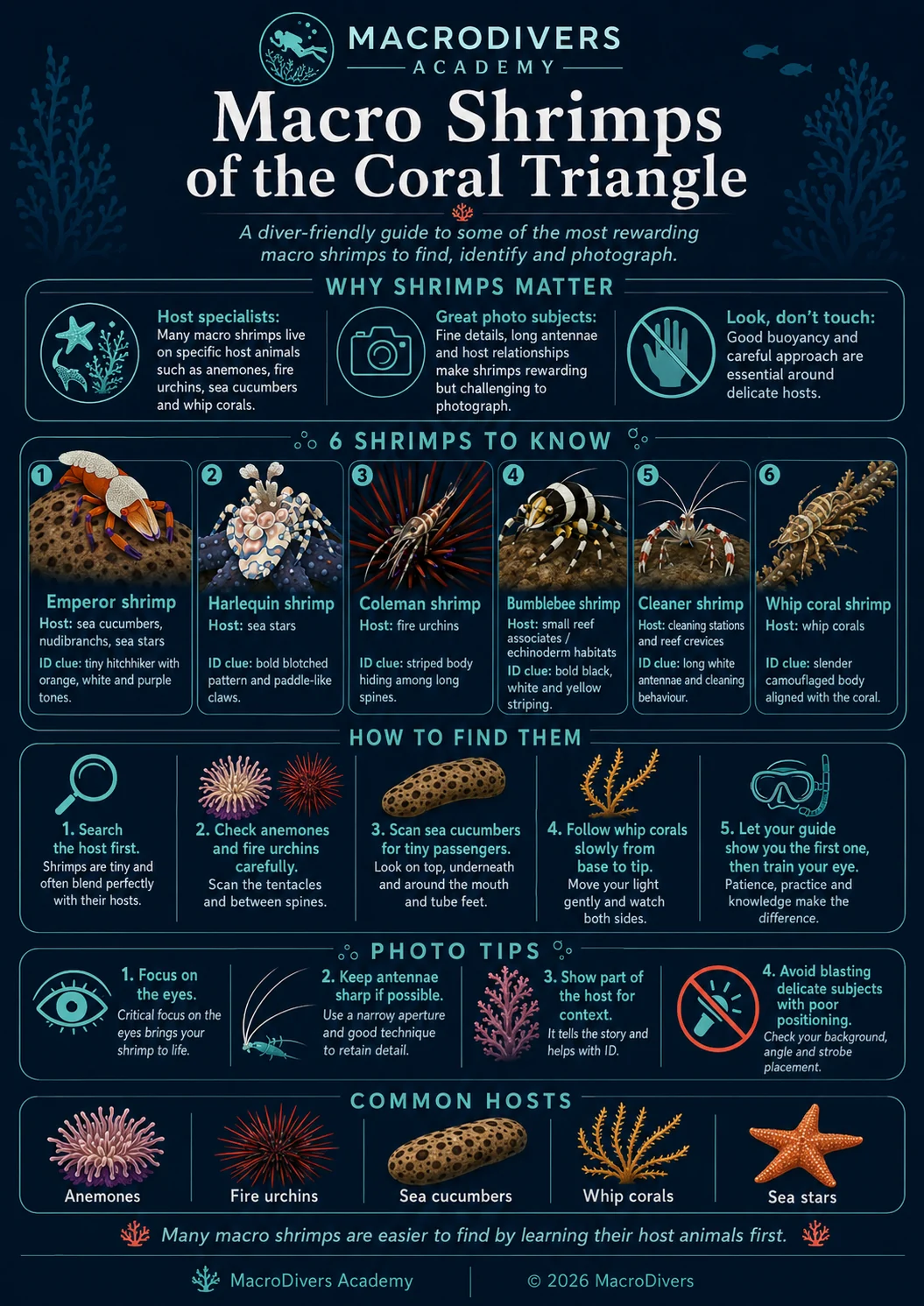
Many macro shrimps live on or near specific host animals. Sea cucumbers, sea stars, fire urchins, anemones and whip corals are often better search targets than the shrimp itself.
Fine legs, eyes, long antennae, eggs, cleaning behaviour and host relationships all help tell a stronger story than a simple portrait.
Many shrimp hosts are delicate or defensive. Avoid poking, moving, lifting or manipulating host animals to reveal a hidden shrimp.
Host / habitat: Sea cucumbers, nudibranchs, sea stars and other larger invertebrates.
ID clue: Tiny hitchhiker with orange, white and purple tones, often seen riding on a host animal.
A favourite macro subject because the host relationship is easy to understand and photograph.
Host / habitat: Usually associated with sea stars, which form part of its specialised diet.
ID clue: Bold blotched pattern, pale body, blue or purple markings and paddle-like claws.
One of the most charismatic macro shrimps, but sightings should be approached carefully.
Host / habitat: Fire urchins.
ID clue: Small striped shrimp living among long urchin spines.
A classic host-specific macro subject. Take care not to damage or harass the urchin while looking.
Host / habitat: Often found around echinoderms, reef rubble or other small host habitats.
ID clue: Bold black, white and yellow banded body.
Small, colourful and memorable, but easily missed unless divers search slowly.
Host / habitat: Cleaning stations, reef crevices, anemones and sheltered reef areas.
ID clue: Long white antennae, bright markings and cleaning behaviour around fish.
Good for explaining reef relationships and behaviour, not just identification.
Host / habitat: Whip corals.
ID clue: Slender camouflaged body aligned along the whip coral.
Look along both sides of the whip coral slowly and avoid touching or bending the coral.
Macro shrimps are often found because their host animal is disturbed. That is exactly what we should avoid. Do not lift sea cucumbers, move sea stars, spread anemone tentacles, bend whip corals or prod fire urchins. A good image is never worth damaging the habitat.
For low-impact technique, read the MacroDivers guides to responsible muck diving and better macro diving. Host-based searching also connects naturally with seahorse observation and nudibranch identification.
Lembeh, Anilao, Bali, Ambon, Dumaguete, Raja Ampat and other muck or reef sites can all be excellent, depending on habitat and guide skill.
The best approach is to search host animals first. Many shrimps live on sea cucumbers, sea stars, fire urchins, anemones, whip corals or reef crevices.
They are not usually an everyday sighting, but they are one of the most sought-after macro shrimp encounters in good Indo-Pacific macro destinations.
Many hosts are fragile, defensive or easily stressed. Touching, lifting or moving them can harm the host and disturb the shrimp.
Yes, but they are small and often difficult to spot. Beginners should focus on buoyancy, slow movement and learning the common host animals.
Compare shrimp host relationships with camouflaged macro crabs.
Read Macro CrabsReturn to the MacroDivers Marine Life Academy hub.
Return to Marine Life GuidesBuild better macro photos with careful approach, lighting and composition.
Improve Photos