Family
Syngnathidae.
Masters of camouflage, delicate swimmers and some of the most rewarding macro subjects for patient divers.
Seahorses are among the most distinctive fish in the ocean. With their upright posture, curled prehensile tails, tube-like snouts and armour-like body plates, they look unlike almost anything else a diver will see.
For macro divers and underwater photographers, seahorses are special subjects because they reward slow observation. They often live among seagrass, algae, coral, rubble, mangroves or gorgonian fans, where they use camouflage and stillness rather than speed.
Pygmy seahorses take this to another level. These tiny specialists can be so well camouflaged against their host corals or algae that even experienced divers may struggle to see them until a guide points them out.
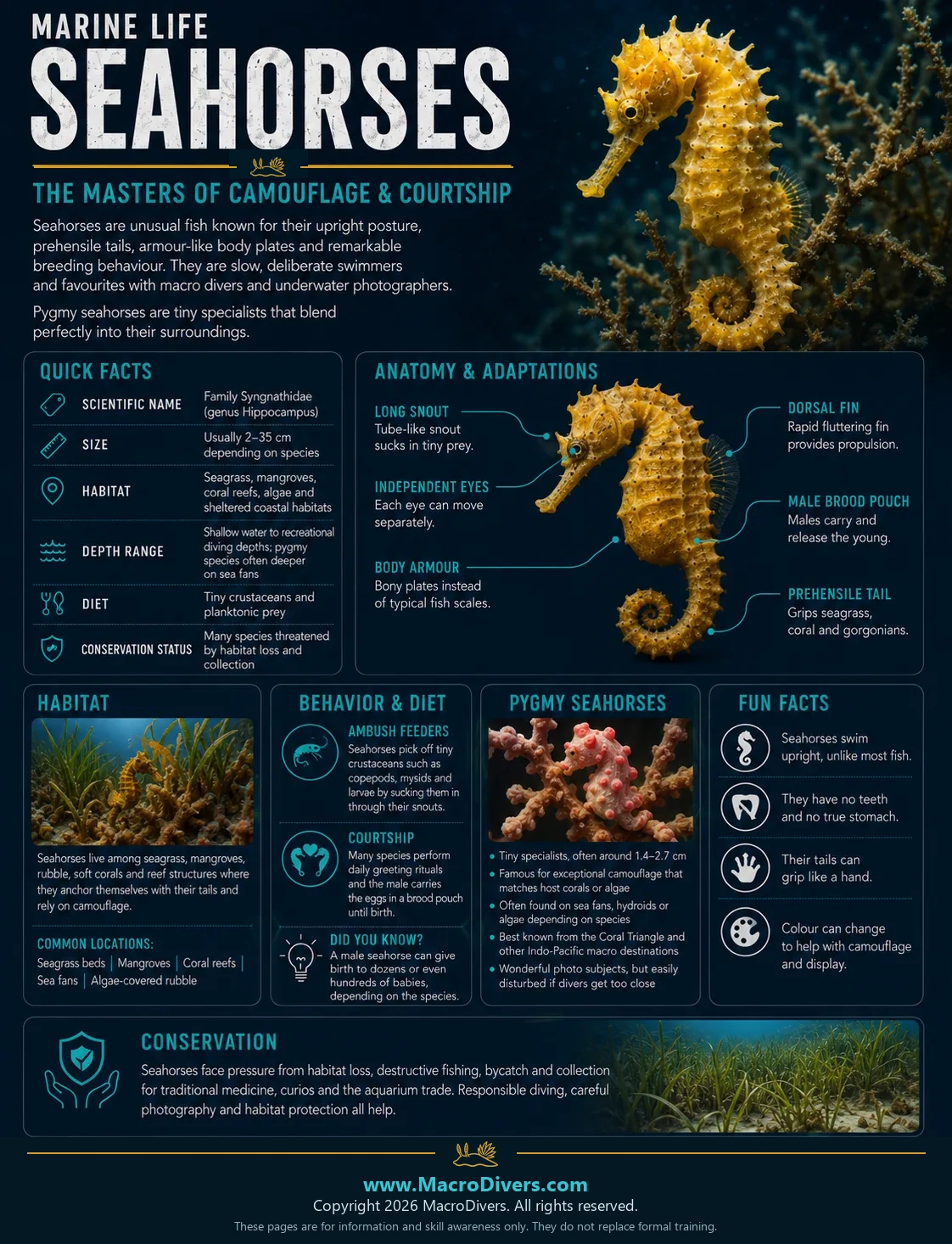
Syngnathidae.
Hippocampus.
Pipefish and seadragons.
Many species are around 2-35 cm, depending on species.
Often around 1.4-2.7 cm, depending on species.
Seagrass, mangroves, coral reefs, rubble, algae and gorgonian fans.
Tiny crustaceans and planktonic prey.
Upright swimming using a small dorsal fin.
Males carry the eggs in a brood pouch.
Camouflage, behaviour, detail and character.
Seahorses are fish, but they do not behave like typical reef fish. They swim upright, have no teeth, no true stomach, and use a long snout to suck in tiny prey. Their bodies are covered in bony plates rather than normal fish scales.
Their tails are prehensile, meaning they can grip. This allows many seahorses to hold onto seagrass, algae, coral branches or other structure while they wait for food to pass by.
One of the most remarkable things about seahorses is reproduction. The female transfers eggs to the male, and the male carries them in a brood pouch until the young are released.
Seahorses use their tube-like snout to suck in tiny prey such as copepods, mysids and small crustaceans.
Each eye can move separately. This helps seahorses scan for food and threats while remaining still.
Instead of typical fish scales, seahorses have bony plates that give the body a rigid, armour-like structure.
A small rapidly fluttering dorsal fin provides propulsion. Seahorses are not strong swimmers.
The tail can grip seagrass, algae, coral or gorgonian branches. This helps the animal stay in position.
Male seahorses carry fertilised eggs in a pouch and later release fully formed young.
Seahorses are found in sheltered coastal and tropical marine habitats around the world. They often live where there is structure to hold onto and camouflage to hide within.
Because many seahorses are poor swimmers, they are vulnerable to habitat damage, careless finning, rough surge and disturbance from divers or photographers.
Pygmy seahorses are among the most exciting macro finds in the Indo-Pacific. They are tiny, highly camouflaged and often associated with specific host corals or algae. Some are so small that they are easier to photograph than to see clearly with the naked eye.
Pygmy seahorses are delicate and can be badly affected by careless photography. Divers should never touch the host coral, move branches, crowd the subject or keep a bright focus light on the animal for long periods.
Seahorses are ambush feeders. They wait for tiny prey to drift or swim close enough, then rapidly suck it in through their snout. They feed on small crustaceans, copepods, mysids and other planktonic animals.
Many species form pair bonds during the breeding season and may perform courtship displays. These can include colour changes, tail holding, rising together in the water and repeated greeting behaviour.
It is best not to overstate lifelong pair bonding. Some species show strong pair bonds, while others vary depending on species, conditions and population density.
Seahorses are delicate animals and poor swimmers. They should never be touched, moved, chased or encouraged into a better position. Their stillness can make photographers forget that the animal is vulnerable.
Seahorses can be beautiful photographic subjects, but they are often challenging. Their faces are narrow, they may turn away, and they often live in messy or delicate habitats. Good seahorse photography is about patience, positioning and restraint.
Seahorses and pygmy seahorses suit compact macro setups well, but the small depth of field can make focus difficult. Use careful positioning, stable buoyancy and patient timing rather than trying to force the subject into a better pose.
The Coral Triangle is a strong region for macro subjects, including pygmy seahorses in suitable reef and gorgonian habitats.
Existing MacroDivers destination pages include Anilao, Ambon and Raja Ampat.
See the macro diving destinations guide for more regional context.
Many seahorse species are under pressure from habitat loss, destructive fishing, bycatch, collection for curios, the aquarium trade and traditional medicine. Their coastal habitats can also be damaged by pollution, development and careless marine activity.
For divers, the practical conservation message is simple: protect the habitat, do not disturb the animal, and support dive operators who value responsible wildlife encounters.
Yes. Seahorses are fish. They belong to the family Syngnathidae, which also includes pipefish and seadragons.
Seahorses have a very different body shape from most fish. They swim upright using a small dorsal fin for propulsion and use their tails to hold onto structure.
Yes. Female seahorses transfer eggs to the male's brood pouch. The male carries the developing young and later releases them.
Pygmy seahorses are tiny seahorses, often only a couple of centimetres long, famous for their camouflage and association with specific coral, algae or hydroid habitats.
No. Seahorses should never be touched, moved or manipulated. Good photography means working with the animal's natural position and behaviour.
Yes. They are tiny, well camouflaged and often live on delicate host corals. Careful buoyancy, gentle lighting and patience are essential.
Slow down and look carefully in suitable habitats such as seagrass, algae, rubble, gorgonian fans and sheltered reef areas. Local dive guides are often very good at spotting them.
Some seahorse species are threatened, while others have different conservation statuses. The main pressures include habitat loss, bycatch and collection.
Seahorses are unforgettable macro subjects, but they are also a good test of a diver's discipline. The best encounters happen when the diver slows down, controls buoyancy, respects the habitat and lets the animal behave naturally.
Read the MacroDivers guide to frogfish camouflage and ambush hunting.
Read FrogfishImprove your critter encounters with calmer, lower impact diving.
Read The GuideBuild better macro photos with careful approach, lighting and composition.
Improve PhotosReturn to the MacroDivers Marine Life Academy hub.
View Marine Life