Masters Of Camouflage
Many pipefish blend into seagrass, algae, hydroids, crinoids and soft corals. Shape and habitat are often more useful than colour alone.
Marine Life
A diver-friendly guide to some of the most rewarding pipefish and ghost pipefish to find, identify and photograph.
Pipefish are close relatives of seahorses and sea dragons, but they are often slimmer, straighter and even harder to spot. In the Coral Triangle, macro divers may find pipefish hiding in seagrass, algae, hydroids, crinoids, rubble and reef edges.
The secret to finding pipefish is usually not colour. It is shape, posture and habitat. Their long snouts, rigid bodies and patient camouflage make them excellent subjects for slow, careful macro diving and underwater photography.
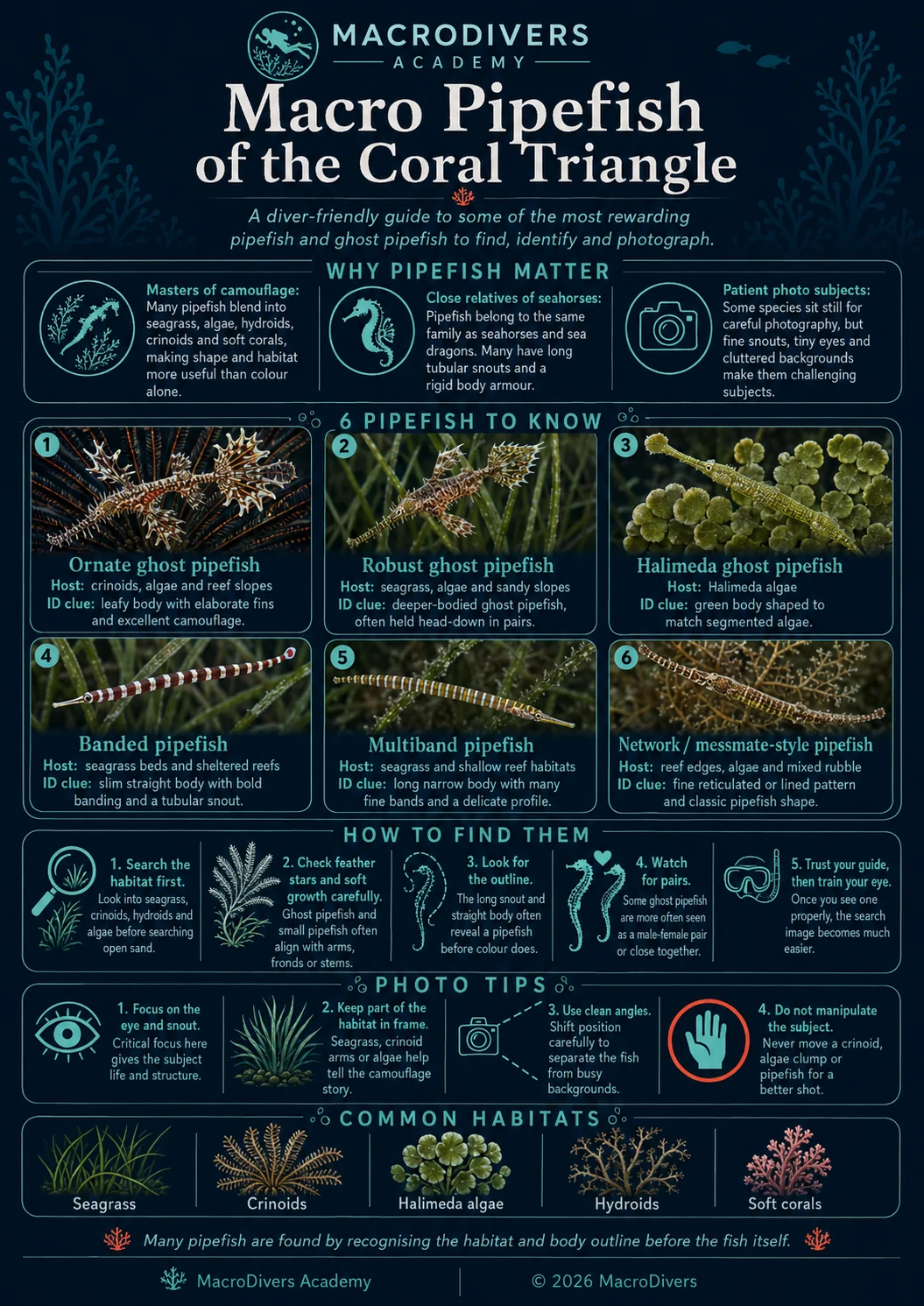
Many pipefish blend into seagrass, algae, hydroids, crinoids and soft corals. Shape and habitat are often more useful than colour alone.
Pipefish belong to the same family as seahorses and sea dragons. Many have long tubular snouts, rigid body armour and a slow, deliberate way of moving.
Some pipefish sit still for careful photography, but fine snouts, tiny eyes and cluttered backgrounds make them challenging macro subjects.
Host / habitat: Crinoids, algae, reef slopes and sheltered areas with fine growth.
ID clue: Leafy body, elaborate fins and excellent camouflage, often matching crinoids or algae.
One of the most iconic ghost pipefish for macro photographers. Look for shape and frilly edges rather than colour alone.
Host / habitat: Seagrass, algae, sandy slopes and rubble areas.
ID clue: Deeper-bodied ghost pipefish, often held head-down and sometimes seen in pairs.
Can look like a drifting piece of weed or leaf. Slow searching is essential.
Host / habitat: Halimeda algae.
ID clue: Green body shaped and coloured to match segmented Halimeda algae.
A perfect example of habitat-based camouflage. Find the algae first, then look for the fish outline.
Host / habitat: Seagrass beds, sheltered reefs, rubble and crevices.
ID clue: Slim straight body with bold banding and a tubular snout.
More obvious than some ghost pipefish, but still easy to miss when tucked into seagrass or shadowed reef edges.
Host / habitat: Seagrass, shallow reef habitats and protected reef margins.
ID clue: Long narrow body with many fine bands and a delicate profile.
A good subject for patient photographers who can control focus on the eye and snout.
Host / habitat: Reef edges, algae, hydroids and mixed rubble.
ID clue: Fine reticulated or lined pattern with the classic long pipefish body shape.
These pipefish are often found by noticing the straight body outline against a busy background.
Pipefish are often found in delicate habitats such as seagrass, crinoids, hydroids and algae. Do not move host material, pull apart feather stars, lift algae or try to reposition the fish. The best pipefish images show natural behaviour and camouflage without disturbing the animal or its habitat.
For low-impact technique, read the MacroDivers guides to responsible muck diving and better macro diving. Good pipefish photography also connects naturally with better macro photography.
Pipefish, seahorses and sea dragons all belong to the same family, Syngnathidae. They share features such as tubular snouts, body armour and unusual reproduction, where males carry the developing eggs. Seahorses tend to be more upright, while many pipefish are longer, straighter and more closely aligned with the habitat around them.
Also explore the MacroDivers guide to seahorses and pygmy seahorses.
Yes. Pipefish, seahorses and sea dragons are all members of the family Syngnathidae. They share features such as tubular snouts, bony body armour and male egg-carrying.
Pipefish are often found in seagrass, algae, hydroids, crinoids, rubble, reef edges and sheltered habitats. Ghost pipefish are especially linked with camouflage around crinoids, algae and soft growth.
Ghost pipefish are delicate, highly camouflaged relatives of pipefish. They often mimic crinoids, algae or seagrass and may be seen hovering head-down or close to a matching host.
Pipefish can be patient subjects, but they are often thin, well camouflaged and surrounded by busy backgrounds. Good buoyancy, careful focus and clean angles are important.
No. Moving habitat or manipulating the subject can damage fragile marine life and disturb natural behaviour. Search slowly and photograph the animal as found.
Compare pipefish with their upright Syngnathidae relatives.
Read SeahorsesReturn to the MacroDivers Marine Life Academy hub.
Return to Marine Life GuidesBuild better macro photos with careful approach, lighting and composition.
Improve Photos